
Hi everyone. The season finale of Hi-Phi Nation, Episode 10, will be out first thing on Wednesday morning, May 3rd. Making a podcast episode is worse than making sausage. Sometimes you have take all the sausage you make, take it all out of the casing, and run in back through the machine again…three or four times, until the texture comes out right. This one has about 20 different people talking in it, so its really tricky.
Author: Barry
Episode 9 is out now.
It is now 1am on Tuesday morning, and I only now completed and uploaded the 9th and penultimate episode of Hi-Phi Nation, Season One. It isn’t every day, month, year, or lifetime that you get an opportunity to interview, and then edit, a legend in the documentary field in your very own documentary. The pressures were heavy, and I ended up making many decisions that probably make this unlike any of the other episodes of Hi-Phi Nation so far. But its out there now for your enjoyment. The season is almost over, so please do take the opportunity to leave a 5-star review on iTunes, Facebook, or whatever podcatcher you use. Or if you can’t, please share the show on your Facebook or Twitter feed. Episode 9: The Ashes of Truth (Apr. 18, 2017)
Audible Ethics podcast
Dear Hi-Phi Nation listeners. Episode 9 will be out tomorrow! In the meantime, I was interviewed on the Audible Ethics podcast, so check it out. https://itunes.apple.com/us/podcast/audible-ethics/id1221546763
Episode 9 and 10 update
I’ve been trying really hard to get you Episode 9 this week, since it will have been three weeks since the last episode. Unfortunately, I’m just not ready. I’m going to postpone the episode for another week while I keep working on how to script and edit it together. I owe it to you to give you the best possible work I can produce, and right now episode 9 is not up to snuff. I am still on schedule to deliver both of the final episodes this month. Meanwhile I am in full-scale production for episodes for season 2 as well. So please send good vibes and you will hear again from me next week.
From raw tape to produced piece
Are you interested in how two different people, with very different backgrounds, concerns, and aesthetic sensibilities can take the same raw material and build very different products from them? As I was putting together Hackademics 1, the show about parapsychology, I sent the raw tape to the Here Be Monsters podcast, which is a far more popular and established show. Jeff Emtman edited and co-wrote my piece there, and he released it yesterday on their podcast. Here is the result. http://www.hbmpodcast.com/. I’d be really curious what your thoughts are about the sound, story, and aesthetic comparisons of the two pieces.
Podcast Playlists like Mixtapes
Dear Hi-Phi Nation fans. RadioPublic is a new app for podcasts available for your iPhone or Android. It is designed within the Public Radio Exchange system, and it is aiming to provide listeners with mixtape-like experiences where showmakers and curators present their mix of episodes across a wide-range of podcasts to introduce people to interesting listening. I just made a playlist called Hidden Conflicts, about the practices in society we take for granted in the world around us, but that once we start thinking about their underlying assumptions, start to unravel. You can get the playlist and the RadioPublic app with lots of other playlists at linked here.
The Future of Hi-Phi Nation
x-posted from Leiter Reports
Two more new episodes remain for season 1 of Hi-Phi Nation at this point, one on the philosophy of love, the other on truth/realism/anti-realism. The stories that bring you there will hopefully be surprising. Hi-Phi Nation is gaining enough of an audience that I think it is worth a gamble for me to do a second season next academic year even at a financial loss. I will be applying to the granting agencies, wealthy foundations, and public media companies, but as many of you know, these are low-probability options in the typical case, even lower probability in nonstandard cases. I’m remembering Ken Taylor’s experiences at the NEH with Philosophy Talk.
For those of you in the profession, I invite the adventurous to take a dive and think about whether you want to produce or partly produce a segment, episode, or a piece of investigative work, that will make it to the second season of the show. Its a new style and a new medium, it might not be a line on your CV, but you will reach people. The work could be within your comfort zone or you can take the full plunge, with a mic and recorder doing embedded philosophizing. All you need to do is contact me, keep up with the Hi-Phi Nation blog/newsletter, the Twitter account, or Facebook page.
For others, if you think there is a value of this work to your students, philosophy clubs, or family or community outreach locally, let me know what kind of episodes I should produce that would bring value to the classes you teach, clubs you advise, discussion groups you lead, etc. When I have time, I will put together sample syllabi and reading lists that make it easy for you to teach with Hi-Phi Nation and other story-driven shows, where the content truly is complimentary rather than supplementary to lectures and readings. If you are a high school or community college teacher already using or committed to using some of the content in your classes, let me know how you’re doing it so I can share it with others.
Thanks to Brian Leiter for giving me a platform this week to talk about this wild ride of a project. Thanks to all the subjects of the first season, and the upcoming subjects in the second, they’re all listed on the website and you hear their voices in the episodes. The first season couldn’t have happened without support from Mark Johnston, Sarah-Jane Leslie, Jennifer Nagel, Tom Kelly, Walter Sinnott-Armstrong, and StoryLab at Duke including Carlos Rojas, Eileen Chow, and Clare Woods.
Ants and the problem of evil
I produced a 5min piece on ants and the problem of evil for Philosophy Phridays at the blog The Daily Ant. Its a fun piece based on a story from the Here Be Monsters podcast.
What is the mood of a piece of philosophy?
X-posted from Leiter Reports
A film has a mood, a story has a mood. What is the mood of philosophy? What is the beauty in a particular argument, its grotesqueness, its tensions, and resolution, and what does that mood sound like?
This is an odd question, but for Hi-Phi Nation, I had to assume that these questions had answers, and I had to answer them. That’s because a good sound-rich piece of audio production has music, sound-tracking, and sound design in general, and that’s the show that I wanted to make for philosophy, which has a lot of other wonderful alternative forms of audio, like Philosophy Bites, Philosophy Talk, Elucidations, History of Philosophy without any Gaps, and so forth. Story-driven audio has an emotion and aesthetic component that you might not notice just like you might fail to notice sound design in film when you are completely engrossed in it, but when you watch a film without a soundtrack, its isn’t a coherent experience. And when you’re trying to do story-driven audio for philosophy, you’re left with this odd, almost category-mistake of a question. But it isn’t a category mistake, and it turns out there are good and bad answers to it, though I will spare you the bad answers in this post.
One note about soundtracking for podcasting; I had to rely on the corpus of open licensed music available for podcasts due to the outdated laws concerning copyright in this country, and my own limitations as a musician (I’m not going to compose and score the thing!). Given these constraints, at the end of a particular edit of an episode, I have to think long and hard about the mood of a piece of philosophy. These are two decisions I made from Episode 3 too illustrate, which features a discussion of revisionist just war theory with Jeff McMahan, Helen Frowe, Major Ian Fishback, and others.
This little clip from a piece by musician Jason Staczek is the most used piece in this season of Hi-Phi Nation. I just love it for philosophy. Its a perfect mix of wonder and puzzlement.
Here is where I use it to explain a famous thought experiment from revisionist just war theory, followed by a statement of the conclusion by Helen Frowe.
The following piece by the group Blue Dot Sessions, who create so much of the music that podcast producers are using these days because they’re open-licensed, is one I put in the folder of “nicely moves the discussion along.” There is a kind of tension I want to create in the presentation of certain philosophical views I think are deserving of tension and anticipation, rather than reflective contemplation. I love this piece for that purpose, and use it a lot in other episodes.
Here is how I use it to draw out one of the most objectionable consequences of Jeff McMahan’s revisionist just war theory.
Scoring and soundtracking has been one of the most pleasing surprises in this project. I definitely do not want to farm it out in the future. If you’re a philosopher, I’d be curious to know what the soundtrack you think is to your work.
How to make Hi-Phi Nation
Cross-posted at Leiter Reports.
The Humanities-writ large initiative at Duke University is responsible for allowing me to work full time this entire academic year to produce the first season of Hi-Phi Nation. I have done nothing but this project, and since it is most likely very different from the daily work flow of professional philosophy, I thought I would share the production process for those interested.
From start to finish, each episode oh Hi-Phi Nation takes about 3 months to complete. I record about 20 hours of raw tape for each 40 minute episode.
Step 1: Read philosophical and other academic work, contact philosophers. Wait for responses for availability.
Step 2: Seek out the subjects of the story; using methods learned in investigative reporting bootcamp; and then contact them.
Step 3: Write out a long list of questions for all subjects, philosophers, and academics.
Step 4: Travel to different location to interview subjects/philosophers, or hire a professional producer to do a tape-sync, or last resort, do a Skype call (quality of audio is everything).
Step 5: Transcribe all interviews with time-stamps every 2min.
Step 6: Take 200 pages of transcriptions/episode, highlight quotable lines. Cut and paste quotables into one document. Code each quotation by theme, topic, and arrange “Tom Cruise-Minority Report” style.
Step 7. Delete all “ums” “uhs” false starts, and gaps in audio clips.
Step 8. Write a script around the story, around the philosophy, and organize the audio around the script.
Step 9: Record. Listen. Rewrite. Rerecord. Listen. Rewrite. Rerecord.
Step 10: Get wife to listen to draft, redo with her notes.
Step 11:. Sit and listen to 20-30 music tracks. Select tracks, mix, cut, and loop for scoring, soundtracking, and soundscaping. Insert into episode at strategic moments of wonder, reflection, curiosity, outrage, etc.
Step 12: Adjust EQs for each voice, adjust loudness meters and compression for whole episode.
Step 13. Go home, bathe toddler, sing her to sleep.
Step 14. Write the show notes for upload by midnight.
Step 15: Repeat x10 for Season 1.
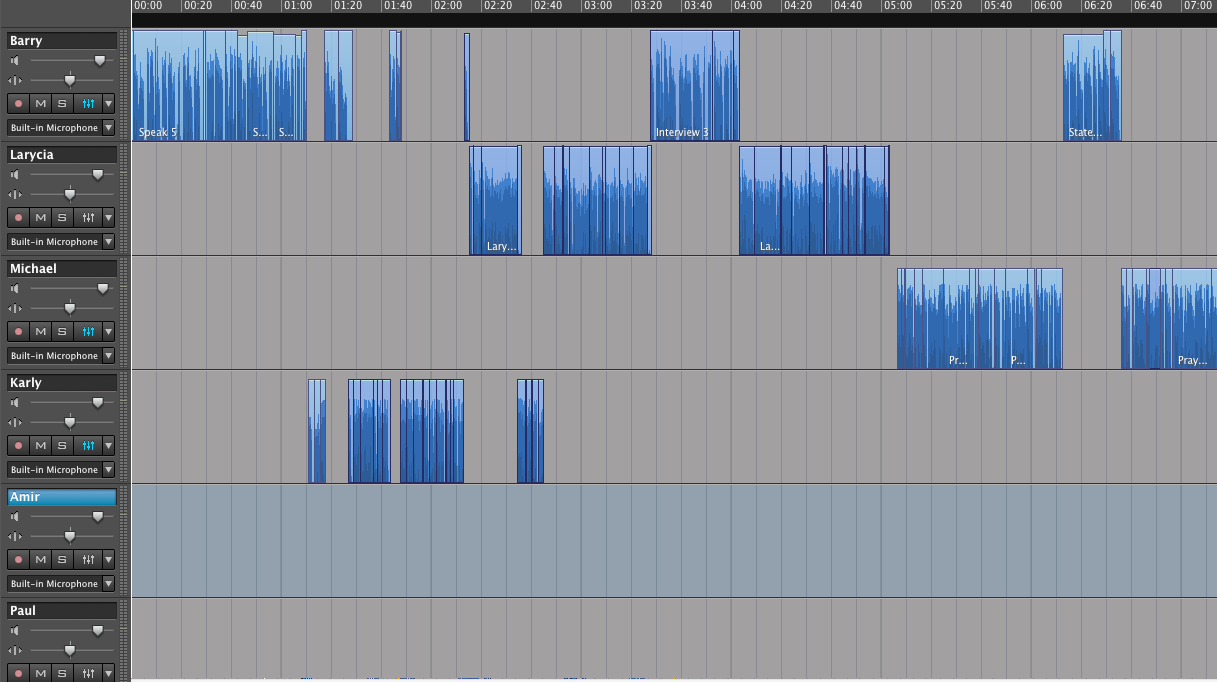
What a mix looks like. This is the opening to Episode 4: 
 Hi-Phi Nation